


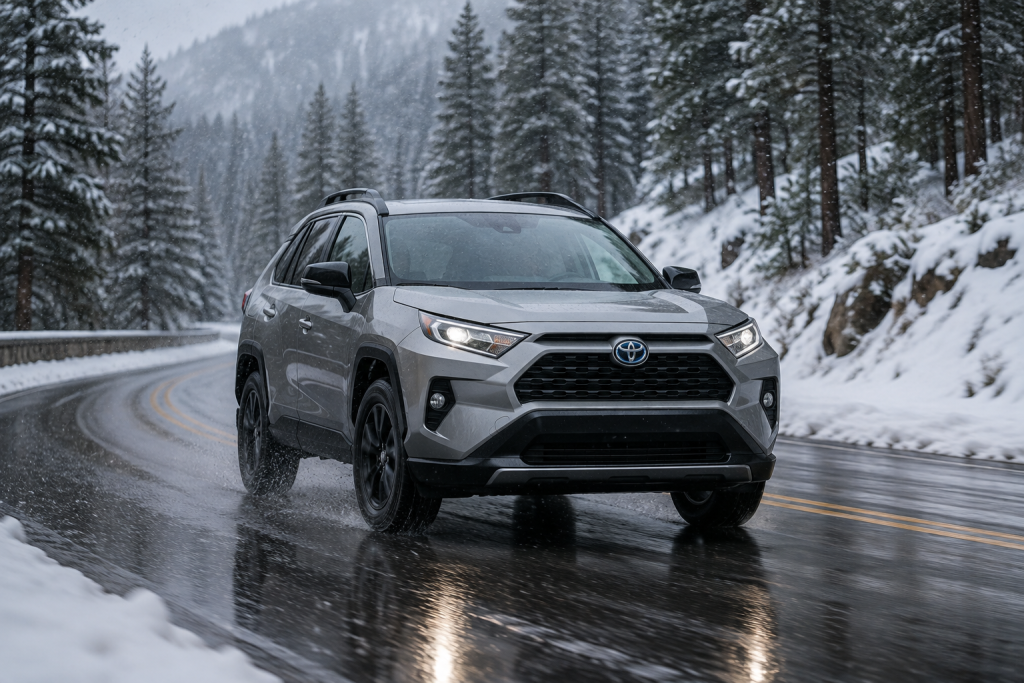
Shopping for a Toyota it might seem like adding All Wheel Drive is just an obvious decision-more traction sounds like an advantage, especially if you drive in the rain, snow, hills, or slippery situations. While more traction sounds appealing, it’s not always a necessity in a vehicle. For some, Front Wheel Drive could be fine for everyday driving, while others might simply prefer the extra grip an AWD Toyota can offer when the roads turn nasty.The real question isn’t whether AWD is better; it’s whether AWD is better for the way you actually drive. There are several kinds of AWD used throughout the Toyota lineup, so not all AWD systems will be the same.
Some are designed to automatically transfer power to the rear wheels when they sense a loss in traction, while some Toyota drivetrains are intended for rougher terrain.
1. What Does AWD Actually Do?
All-wheel-drive distributes power between the front and rear wheels in order to maintain traction when conditions aren’t so predictable. Instead of only relying on the rear wheels or front wheels, an all-wheel-drive vehicle utilizes the front and rear wheels, which can be especially beneficial when accelerating out of a slippery intersection, going up a wet hill, or driving over a surface that has changing conditions for traction second to second. Toyota’s all-wheel-drive technology senses information such as wheel speed and driving inputs and then tells power where to go. On the 2026 RAV4, for example, the system can anticipate front-wheel acceleration and send driving force to the rear wheels as well as sense wheel slip at the front wheels.
2. Do You Need AWD on Dry Roads?
For most drivers: no. If your daily routine includes highway commutes, grocery trips, and highway driving on mostly dry road surfaces, then a front-wheel drive Toyota probably already does all you need it to do. FWD can also work if an easy, fuel-efficient vehicle is more of your priority than extra traction.AWD, though, can be useful even when road surfaces are not covered in snow. The added traction can be helpful on take-offs, on-ramps, on turns, and on roads where driving conditions may fluctuate. It may not be something you notice on every single drive, but on drives with variable traction conditions, the added advantage will be clearer.
3. Does AWD Help in Snow and Rain?
Yes, but we need to be clear about what AWD is of assistance with: on snow, ice, or other slippery conditions, AWD is of assistance to distribute power to attempt to maintain traction while accelerating. This is of particular benefit when starting from a stop, going up a slick hill, or during portions of road where grip may be limited.Rain can cause issues as well, while generally to a lesser degree than snow or ice. Slippery surfaces due to water may be encountered, particularly when moving up to speed. Toyota’s AWD systems are designed to react to varying conditions of traction and are capable of providing assistance where more traction may be beneficial.
4. AWD vs. FWD: Which One Makes More Sense?
If most of your driving is done on pavement and severe winter conditions aren’t an issue, a FWD Toyota might be a good choice for you. FWD offers ample traction for most daily driving situations like commuting, errands, road trips, and highway driving, so you don’t need to spring for AWD if it’s just not something you want.If you regularly drive in snowy, wet, steep, gravelly, or erratic conditions, AWD might be more beneficial. It may also be beneficial if you plan many road trips and want to ensure you always have that available traction if conditions or weather become questionable.Toyota gives buyers choices in what’s available; take the 2026 RAV4 as an example. Some of the hybrid trims of the RAV4 are available as FWD or AWD, while other trims come standard with AWD, so buyers can choose what fits their needs.
5. Does AWD Affect Fuel Economy?
It can. The physical weight and drivetrain attributes of an AWD vehicle usually come at a fuel-economy cost compared to the same vehicle in a front-wheel-drive setup. Which car and how much depends on the particular Toyota model, powertrain, trim, and the type of AWD setup offered.Toyota also puts electric motor-powered AWD setups on some of their hybrid models, including the 2026 RAV4 Hybrid with an AWD option delivered via a rear electric motor, and as a standard feature on its PHEV models.So you shouldn’t just take that AWD tax and apply it uniformly to everything with a Toyota badge and two drive wheels: Check what specific AWD powertrain is standard or available on the configuration of any Toyota model you’re interested in, if fuel economy is paramount.
Find Your Toyota at Sansone Toyota
If you’re on the fence between FWD and AWD, scope out the current Toyotas in our inventory to see how each drivetrain could adapt to your usual routine. Think about your daily route, your local climate conditions, the kind of terrain you travel for weekend excursions and everyday drives, and even how many passengers you can usually squeeze in. This process should tell you more than the vague advantages of AWD.If it’s time for a new vehicle to handle everything, head over to Sansone Toyota!You can explore their new and used inventory of popular Toyota models, including RAV4, Camry, Corolla, Highlander, and others. Don’t forget to filter by drivetrain on each model’s individual listing to learn more about your new vehicle.
Connect with us


Recent Blog Entries
- 2026 Toyota Lineup at Sansone Toyota: Find the Right Vehicle for Your Lifestyle
- What Should You Know Before Buying a Hybrid in 2026?
- Do You Really Need AWD? When Toyota All-Wheel Drive Actually Makes a Difference
- Explore the 2026 Toyota C-HR SE Near North Woodbridge, NJ | Sansone Toyota
- Explore the 2026 Toyota Prius Plug-in Hybrid XSE Premium Near North Woodbridge, NJ | Sansone Toyota